
Docket PV-010 · Brand Strategy · 1966
Amul has let a cartoon girl comment on the news since 1966
On trial: Was Amul right to build its brand for six decades on topical ads in which the Amul girl comments on the news?
PASS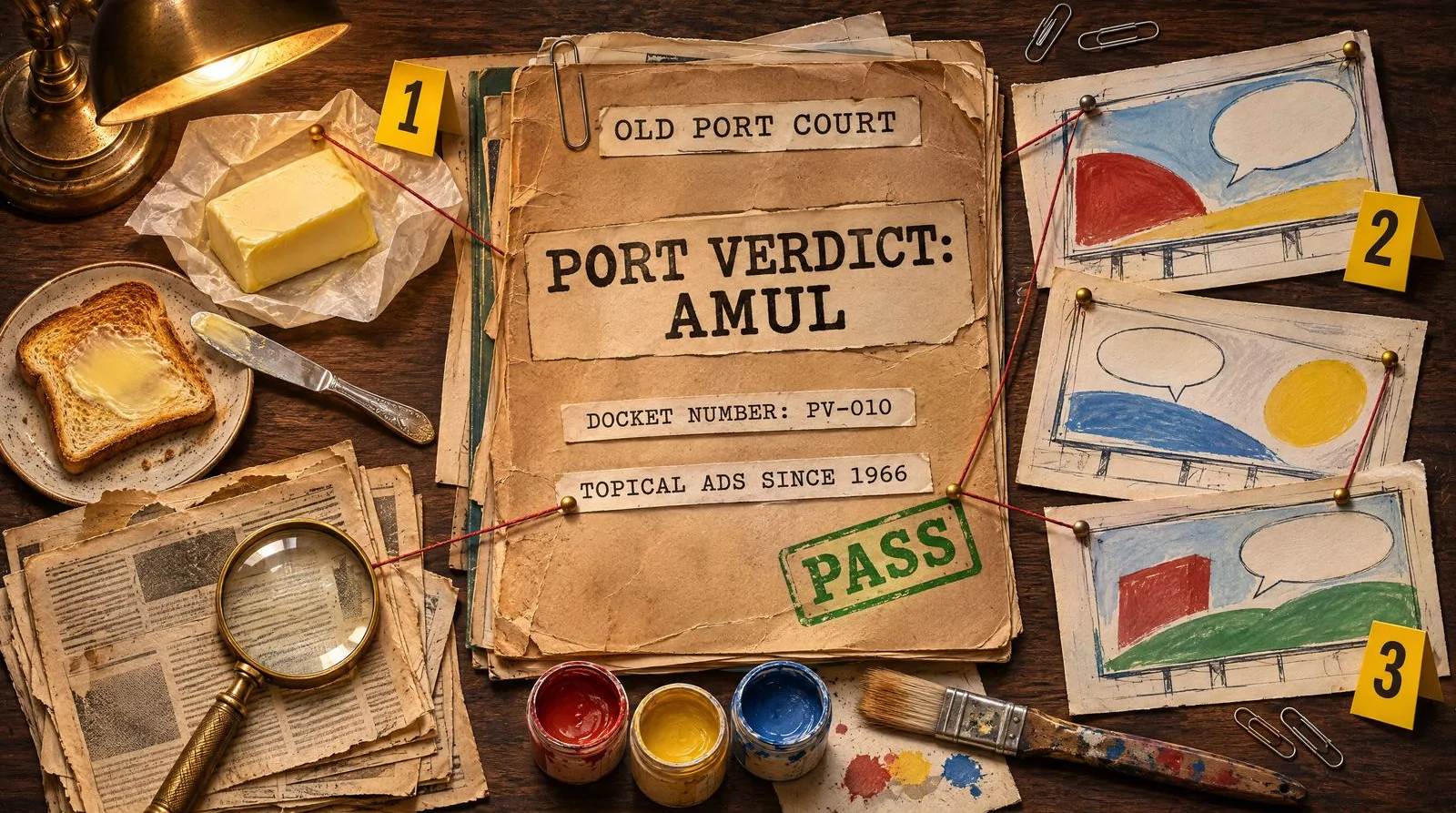
The case in brief
Since October 1966 the Amul girl has appeared in topical ads that pun on the week's news, produced by the daCunha agency for the dairy cooperative behind Amul. The approach has survived threats, withdrawn hoardings and a Twitter block, on a budget Amul says has stayed under one percent of turnover.
The case in numbers
The case
In 1966 the Gujarat cooperative behind Amul butter needed an answer to Polson, a rival whose logo showed a girl buttering bread. Sylvester daCunha, whose agency had won the account, and his art director Eustace Fernandes created a chubby moppet with big eyes, short hair and a polka-dotted frock. According to Amul's own history, the first hoardings went up in October 1966, showing her on a horse with the line "Thoroughbread. Utterly Butterly Delicious Amul." By the late 1960s the ads had found the idea that would define the brand: in 1969, as the Hare Krishna movement arrived in Bombay, the girl appeared with "Hurry Amul, Hurry Hurry". From then on she would comment on whatever India was talking about, with a pun that tied the news back to butter.
The decision on trial is a long-term one. Amul chose a single character, a single format and a willingness to joke about politics, sport, cinema and scandal, and it has stuck with that choice for nearly sixty years. Most brands change campaigns every few years. Was Amul's consistency, and its appetite for risk, the right way to build a mass food brand?
The evidence
How long and how much
When the campaign turned 50, Business Standard reported that it had produced more than 4,000 creatives. Rahul daCunha, Sylvester's son and the agency's creative head, said output had grown from one creative a month in the early years to five or six a week. Sylvester's wife Nisha daCunha is credited with the jingle. Cartoonist Jayant Rane painted the creatives and copywriter Manish Jhaveri wrote the lines, and the team had grown to about ten people because taglines now also ran in regional languages. Sylvester daCunha died in June 2023, aged 80. Amul's managing director Jayen Mehta announced his death and called him a doyen of Indian advertising, as reported by ThePrint. The agency is now headed by Rahul.
What it costs
The campaign has always been cheap by FMCG standards. In 2014 R S Sodhi, then managing director of the Gujarat Cooperative Milk Marketing Federation (GCMMF), told exchange4media that Amul's advertising spend had always been less than one percent of turnover, and that every product is promoted under the single Amul umbrella. That figure is Amul's own and is not independently audited, but the topical format itself, built on hoardings, press insertions and later social posts, is cheap to produce. Over the same decades the business grew enormously. Amul's history page records butter sales rising from about 1,000 tonnes a year in 1966 to over 25,000 tonnes by 1997, and GCMMF reported turnover of Rs 65,911 crore for 2024 to 2025. Distribution, pricing and the cooperative model all contributed to that growth, so the campaign cannot claim it all.
The bans, threats and backlash
Rahul daCunha told The National that the character was a master move because she could comment on potentially sensitive subjects without offending anyone. The record shows that has not always held. Commenting on the news means upsetting people in the news. Amul's own history records that Indian Airlines threatened to stop serving Amul butter on its flights unless an ad about an airline strike came down, and the agency withdrew it. Officials objected when the girl wore a Gandhi cap, and those hoardings were wiped clean. A Ganesh festival ad drew a Shiv Sena threat to destroy the agency's office. The National reports that during the 1975 to 1977 Emergency the campaign joked about compulsory sterilisation, that cricket administrator Jagmohan Dalmiya threatened to sue for Rs 500 crore over an ad, and that a 2019 ad on the removal of Article 370 drew criticism online. In June 2020, Twitter briefly blocked Amul's account after it posted "Exit the Dragon?", a cartoon linked to calls to boycott Chinese products. Sodhi told Business Standard that Amul had not run a campaign against anybody and that the mascot reflects the mood of the nation in a funny way. The account was restored on 6 June.
The record claims
The campaign is often described as the world's longest-running, but we could not find a verified Guinness World Records title. Amul's own history page once said the ads were "ready to enter" the Guinness Book. The National describes it as "purportedly" the longest-running outdoor campaign in the world, and ThePrint calls it the longest continuously running campaign built on a single character. All three are claims, not a certified record. Its longevity since 1966 is not in doubt.
The verdict
PASS. Few brand decisions anywhere have compounded for as long. A single character gave Amul instant recognition across languages and literacy levels. The topical format gave the brand a reason to appear several times a week without new production budgets, and the jokes kept a commodity product in daily conversation. The low cost meant the campaign never had to justify itself against a large media bill.
The caveats are real. The format depends on editorial judgement by a small team, and the line between satire and offence has moved; Rahul daCunha told The National that his father never got immediate feedback, whereas reactions now arrive within seconds. The agency has become selective: Business Standard noted that it waited eight days after the Uri attack before commenting. And because Amul's growth rests on its cooperative supply chain and pricing, the campaign's commercial contribution cannot be isolated. Its value is fame and affection, and on that measure it has few peers.
What Indian brands can take from it
- Pick one character and keep it. Sixty years of the same girl built recognition no rotating campaign could buy.
- Make topicality a system, not a stunt. A small, stable team with a fixed format can respond to the news every week at low cost.
- Know which stories to skip. Amul's restraint after national tragedies protects the licence to joke the rest of the time.
- Accept that wit will sometimes cost you. Withdrawn hoardings and angry officials are the price of a brand people actually talk about.
Building a consistent brand voice is the work of our brand strategy and social media management teams. For taking topical content into more languages, see our guide to regional language content in India.
Timeline
The first Amul girl hoardings appear, with the line "Utterly Butterly Delicious".
During the Emergency, an Amul ad jokes about compulsory sterilisation.
At 50, the campaign has produced more than 4,000 creatives.
Amul's Twitter account is restored after a brief block that followed its "Exit the Dragon?" post.
Amul announces the death of Sylvester daCunha, the campaign's creator.
GCMMF reports 2024 to 2025 turnover of Rs 65,911 crore, up 11 percent.
Lessons for Indian brands
- A single character used consistently for decades can become a brand asset worth more than any one campaign.
- Topical marketing works best as a low-cost, repeatable system run by a small, stable team.
- Commenting on the news means some ads will be withdrawn or attacked, so brands need clear limits on what they will joke about.
- Claims of world records should be checked against a certifying body before they are repeated.
Questions people ask
Who created the Amul girl?
Sylvester daCunha, whose agency handled the Amul account, created her in 1966 with art director Eustace Fernandes. His son Rahul daCunha now heads the agency.
Is the Amul ad campaign in the Guinness World Records?
We could not find a verified Guinness World Records title. It is widely described as one of the world's longest-running campaigns, but that is a claim rather than a certified record.
Have Amul ads ever been banned or withdrawn?
Yes. Amul's own history records that an ad about an Indian Airlines strike was withdrawn after the airline threatened to stop serving Amul butter, and Gandhi cap hoardings were wiped clean after official objections. In 2020 Twitter briefly blocked Amul's account after a China-related post.
How much does Amul spend on advertising?
In 2014 R S Sodhi, then GCMMF's managing director, said Amul's advertising spend had always been less than one percent of turnover. Amul has not published an independent breakdown.
Evidence
- Amul: Amul topical story
- Business Standard: Swinging at fifty
- The National: India's most famous ad campaign, how the Amul butter girl has been churning up debate for 50 years
- exchange4media: Amul's advertising spends have always been less than 1% of turnover, R S Sodhi
- Business Standard: Amul Twitter account blocked briefly after it posted ad targeting China
- ThePrint: Ad guru Sylvester daCunha dies at 80, his Amul girl lives on
- The Week (PTI): GCMMF revenue rises 11% in FY25 to Rs 65,911 crore
Port Verdict is independent commentary based on public sources. Brand names are trademarks of their owners; no affiliation is implied.