
Docket PV-009 · Crisis Communications · 2024
Zomato dressed a pure veg fleet in green and undid it within a day
On trial: Was Zomato right to launch a green-uniformed pure veg delivery fleet, and did its fast reversal rescue the decision?
FAIL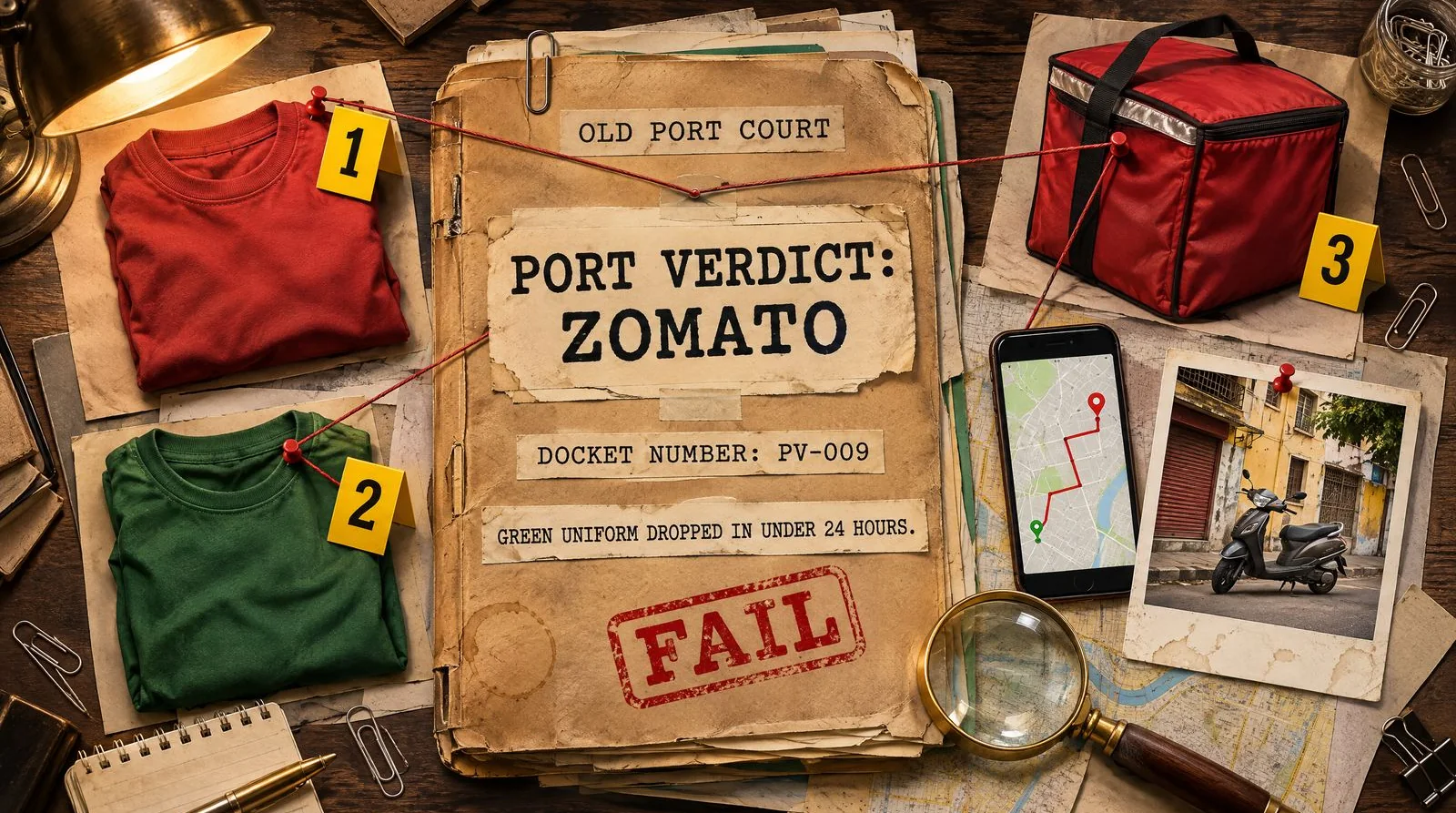
The case in brief
On 19 March 2024 Zomato launched a Pure Veg Mode and a Pure Veg Fleet whose riders would carry green boxes instead of red. Within a day the green was gone after warnings about discrimination and rider safety, and within two days the word "pure" had gone too.
The case in numbers
The case
On 19 March 2024, Zomato's founder and chief executive Deepinder Goyal announced two features on X. Pure Veg Mode would show customers only restaurants that serve exclusively vegetarian food. The Pure Veg Fleet would deliver those orders with riders who never carried non-vegetarian food. To make the fleet visible, its riders would use green delivery boxes and uniforms rather than Zomato's usual red. Any non-vegetarian meal, or a vegetarian meal from a restaurant that also served meat, would never go inside a green box, and green-box riders would not enter non-vegetarian restaurants. Goyal said, as reported by Business Today, that India has the largest percentage of vegetarians in the world, and that such customers are very particular about how their food is cooked and handled. Zomato said the mode did not include or exclude any religious or political preference.
The customer need was real. A large Pew Research Center survey found that 39 percent of Indian adults describe themselves as vegetarian and 81 percent restrict meat in some way. What is on trial is the way Zomato chose to serve that need, by colour coding its workforce in public, and how it handled the reaction.
The evidence
Zomato saw the risk coming
In a late-night post on launch day, Goyal repeated that the feature strictly served a dietary preference and promised that if Zomato saw "any significant negative social repercussions" it would roll the change back "in a heartbeat", as reported by PTI in The Week. That pre-emptive promise is revealing. The company knew the launch touched sensitive ground and shipped it anyway.
The backlash and its substance
The criticism was not only about tone. Journalist Fatima Khan warned the initiative could lead to more discrimination against delivery agents, and Dalit writer and activist Shalin Maria Lawrence called it casteist, according to PTI. BOOM reported that unions, academics and users argued that separating workers by clothing colour could lead to harassment on the ground, and that "pure" echoed caste-based ideas of purity. The most practical objection came from users who pointed out that housing societies and resident welfare associations might bar red-uniformed riders altogether once a green alternative existed. A visual signal designed to reassure vegetarian customers could become a way to exclude everyone else. Some users also questioned the inefficiency of splitting orders across two fleets. Others welcomed the feature as a simple way to find vegetarian restaurants and avoid mix-ups.
The context explains why the reaction was so fast. BOOM listed existing forms of food-linked exclusion that delivery workers already face, including separate entrances, limits on using restrooms and housing societies that restrict non-vegetarian food. A uniform that told every gatekeeper which kind of food a rider carried slotted straight into those practices. The criticism was therefore about foreseeable harm to low-paid workers, not about whether vegetarian customers deserved a choice.
The reversal
On 20 March, less than 24 hours after the launch by PTI's account and in under 11 hours by BOOM's, Goyal posted that all riders, on both the regular fleet and the vegetarian fleet, would wear red. The separate fleet stayed, but customers would see in the app, not on the street, which fleet carried their order. He said the change would stop red-uniformed riders being wrongly associated with non-vegetarian food or blocked by societies, that riders' physical safety was paramount, and that Zomato now realised even some customers could get into trouble with their landlords. He told critics: "You made us understand the unintended consequences of this rollout." On 21 March Zomato said on X that, based on feedback, Pure Veg Mode would be renamed "veg only" mode, and that delivery partners would never be discriminated against on any criteria, exchange4media reported.
The brand's own precedent
The launch sat awkwardly with Zomato's history. In July 2019, when a customer in Jabalpur cancelled an order because his rider was not Hindu, the company replied that food does not have a religion, "it is a religion", and Goyal said Zomato was not sorry to lose business that came in the way of its values, as Al Jazeera reported. A uniform that sorted riders by what they carried cut against that stance. We found no mention of the veg-only fleet in Zomato's shareholder letter for the January to March 2024 quarter, and no published evidence of lasting commercial damage either way.
The verdict
FAIL. The underlying product idea was defensible, and part of it survived. With four in ten adults calling themselves vegetarian, a filter for vegetarian-only kitchens and a dedicated delivery fleet had clear commercial logic. The failure was in the execution that made it news: a public, colour-coded split of the workforce in a country where food, caste and religion are tightly linked. The two most visible parts of the launch, the green uniform and the word "pure", were withdrawn within two days. A launch that has to be dismantled that quickly did not pass basic pre-launch scrutiny, and Goyal's own promise of a fast rollback shows the risk was foreseeable.
The reversal deserves real credit. It was fast, it came from the founder in his own words, it named the people at risk, the riders, and it kept the part of the service customers wanted. That turned a potential long-running controversy into a two-day story. Good crisis handling limited the damage. It did not make the original decision right.
What Indian brands can take from it
- Test signals with the people who carry them. Riders, not customers, bore the risk of the green uniform. Ask frontline staff before you label them.
- Watch your words around food, caste and religion. "Pure" carried meaning Zomato did not intend. A neutral term like "veg only" was available from the start.
- Keep the need, drop the signal. Zomato's fix kept the separate fleet and moved the distinction into the app, where it helped the customer without marking the worker.
- If you promise a rollback, define the trigger. Know in advance what evidence will make you reverse, and who decides, so the U-turn is a plan rather than a scramble.
Our brand strategy and social media management teams help brands pressure-test sensitive launches and plan their response before they go live.
Timeline
Zomato tells a Jabalpur customer who rejected a rider over religion that food does not have a religion.
Deepinder Goyal announces Pure Veg Mode and a Pure Veg Fleet with green boxes and uniforms.
In a late-night post, Goyal promises to roll back "in a heartbeat" if there are serious repercussions.
Goyal drops the green uniform; all riders will wear red and the veg fleet is shown only in the app.
Zomato says Pure Veg Mode will be renamed "veg only" mode.
Zomato's Q4 FY24 shareholder letter makes no mention of the veg-only fleet.
Lessons for Indian brands
- A real customer need can still produce a failed launch if the way it is signalled in public divides people.
- Frontline workers who will carry a new label should be consulted before the label is announced.
- A fast, founder-led reversal that names the people at risk can shrink a crisis to a couple of days.
- Promising to roll back if things go wrong is a sign that the launch needed more testing first.
Questions people ask
What was Zomato's pure veg fleet?
Launched on 19 March 2024, it was a separate group of delivery riders who carried orders only from pure vegetarian restaurants. They were to use green boxes and uniforms instead of Zomato's usual red.
Why did Zomato roll back the green uniform?
Critics warned that colour coding riders could lead to discrimination and that housing societies might bar red-uniformed riders. Deepinder Goyal said riders' physical safety was paramount and switched all riders back to red on 20 March 2024.
What happened to Zomato's veg-only option after the backlash?
Zomato kept a separate fleet for vegetarian orders after the rollback, identified only in the app, and renamed Pure Veg Mode to "veg only" mode on 21 March 2024.
How quickly did Zomato reverse the decision?
The green uniform was dropped less than 24 hours after launch, according to PTI. The word "pure" was dropped two days after launch.
Evidence
- Business Today: Zomato launches pure veg mode and pure veg fleet, all you need to know
- The Week (PTI): Zomato rolls back green uniform for veg deliveries after criticism
- The Tribune: Zomato rolls back green uniform for pure veg fleet in late-night post amid backlash
- afaqs: Zomato withdraws green dress code for pure veg fleet
- exchange4media: Zomato renames pure veg mode to veg only
- BOOM: Zomato pure veg fleet exposes India's food fault lines
- Pew Research Center: Eight in ten Indians limit meat in their diets, and four in ten consider themselves vegetarian
- Al Jazeera: India police warn Hindu man for rejecting Muslim Zomato driver
- NSE: Zomato Q4 FY24 shareholder letter
Port Verdict is independent commentary based on public sources. Brand names are trademarks of their owners; no affiliation is implied.