
Docket PV-006 · Advertising · 2017
Pepsi put Kendall Jenner at a protest and pulled the ad within a day
On trial: Was Pepsi right to make and release an ad that used protest imagery to sell a soft drink?
FAIL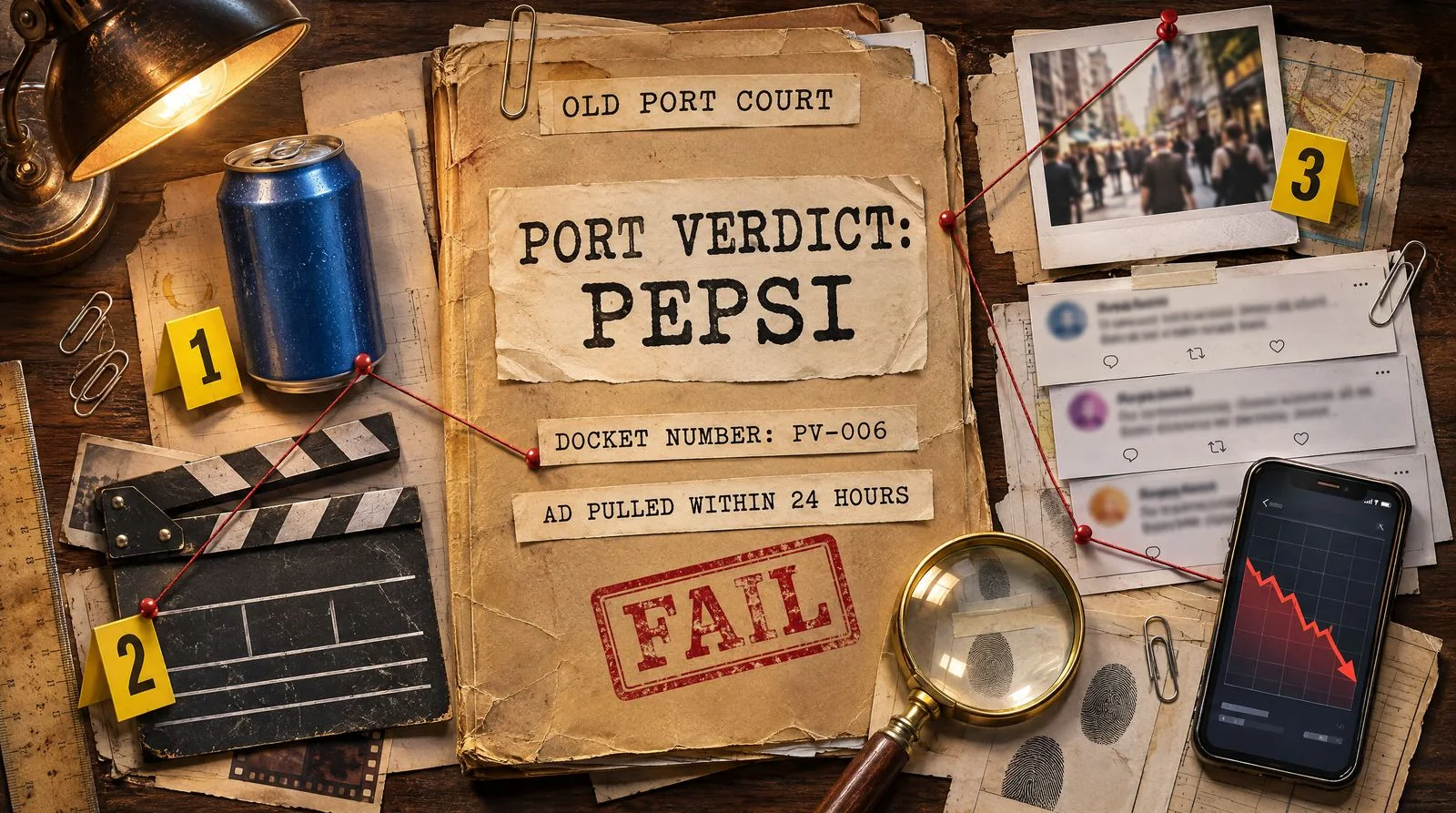
The case in brief
In April 2017 Pepsi released Jump In, an in-house film in which Kendall Jenner hands a police officer a Pepsi at a street protest. After widespread criticism it was withdrawn within about a day, and YouGov data showed sharp short-term falls in buzz and purchase consideration.
The case in numbers
The case
On 4 April 2017 Pepsi released Jump In, a short film of about two and a half minutes in its Live for Now "Moments" campaign. In it, Kendall Jenner walks away from a photo shoot, wipes off her make-up, joins a passing street protest and hands a police officer a can of Pepsi. The officer smiles and the crowd cheers. Pepsi described the campaign to CNBC as reflecting the millennial generation and showing "emotional connections" that bring people together. It ended on the line "Live bolder, live louder, live for now."
The ad was made by Creators League Studio, the in-house content studio PepsiCo had opened in Manhattan in 2016. When it launched, Brad Jakeman, president of PepsiCo's global beverage group, told Marketing Dive that the aim was for brands "to essentially fund their own marketing", which he called the holy grail. The decision on trial is the creative and approval choice: to use the imagery of protest and policing to sell a soft drink, through an in-house process, and release it globally.
The evidence
How it was made and approved
Because the work was produced in-house, there was no outside agency between the idea and the brand. Critics quoted by Campaign argued that the lack of an external agency, and of diversity on the creative team, were likely factors in what went wrong. That is their view rather than an established finding, but the company's own account points in a similar direction. Campaign reported that Jakeman tweeted his pride in the spot on the afternoon it launched, then later deleted the tweet.
In September 2017, PepsiCo chief executive Indra Nooyi told Fortune that she had watched the ad several times before release and had not linked the final scene to real-world protests. "I had not seen that scene. And I take everything personally," she said, describing the event in the film as a peace march rather than a protest march. "The minute I saw people upset, I pulled it." Her account suggests that the approval chain, up to the chief executive, did not test the work against how a wide audience would read it.
The reaction and the withdrawal
Criticism was immediate and came from many directions. Viewers said the ad trivialised serious issues and used them for commercial gain, and many linked its final scene to recent protests over policing. Bernice King, daughter of Martin Luther King Jr, posted a photograph of her father at a police line with the caption "If only Daddy would have known about the power of Pepsi", as reported by BeverageDaily.
Pepsi first defended the work. Its initial statement, quoted by Marketing Dive from Adweek, called it "a global ad that reflects people from different walks of life coming together in a spirit of harmony". By the following afternoon, 5 April, it had reversed course. "Pepsi was trying to project a global message of unity, peace and understanding. Clearly we missed the mark, and we apologize," the company said, adding that it did not intend to make light of any serious issue, was removing the content and halting any further rollout, and apologised for putting Kendall Jenner in that position. The ad came down from YouTube, though copies kept circulating.
What the brand data shows
The most consistent public data comes from YouGov BrandIndex, which surveys US consumers daily. YouGov reported that the share of adults who would consider Pepsi next time they bought a soft drink fell from 28 percent on 4 April to 20 percent on 12 April, then recovered to 24 percent about a week later. Its Buzz score, which nets positive against negative things people have heard about a brand, fell from 9 to minus 7 over the same week.
The longer view is more mixed. A year later, YouGov found that among millennials, Pepsi's perception hit its lowest level in at least eight years between May and July 2017, then returned to its pre-crisis level after about nine months. Millennial purchase consideration, however, stood at 23 percent, its lowest since April 2015, within a longer decline from 33 percent in 2014 that predates the ad.
There is one counterpoint. A Morning Consult survey of 2,202 people who were shown the ad, reported by Marketing Dive, found that 44 percent said they viewed Pepsi more favourably after watching it. That measures reaction to the film itself when viewed in a survey, without the surrounding coverage, and Marketing Dive noted there was no benchmark to compare it with. PepsiCo has not published any sales impact attributed to the ad.
The verdict
FAIL. The ad put a soft drink at the centre of imagery that many viewers associated with real and painful events, without any history or programme that gave the brand a credible role there. The company's own chief executive said the approval process missed the scene that caused the offence. It was withdrawn within about a day, and the clearest independent tracking shows a sharp, if temporary, fall in buzz and purchase consideration.
The caveats matter. Pepsi's withdrawal was fast and its apology plain, which probably shortened the damage: YouGov's perception measure recovered within about nine months. The Morning Consult survey suggests that many people who simply watched the film did not object to it. No sales loss has been shown, and part of the decline in millennial consideration began years earlier. But a decision that has to be reversed within a day, with an apology to its own star, did not achieve what it set out to do.
What Indian brands can take from it
Indian brands are increasingly tempted to join social conversations in ads and on social media, often at speed through in-house teams. Pepsi's case suggests some guard rails:
- Earn the right to the issue. If your brand has no record of action on a cause, do not borrow its imagery to sell a product.
- Give in-house speed an outside challenge. Put sensitive work in front of reviewers from different backgrounds who are not invested in the idea before it goes live.
- Write the pull plan before launch. Know who can take content down, how fast, and what the apology will say if a release goes wrong.
- Read the right data. Separate buzz, purchase consideration and sales, and treat forced-viewing surveys as reaction to the film, not to the controversy.
Our creative direction team builds this kind of review into campaign development, and our brand strategy work helps define which issues a brand has genuinely earned the right to speak on.
Timeline
PepsiCo opens Creators League Studio, an in-house content studio in Manhattan.
Pepsi releases Jump In starring Kendall Jenner; criticism builds online the same day.
Pepsi pulls the ad, halts its rollout and apologises, including to Kendall Jenner.
YouGov BrandIndex shows purchase consideration down to 20 percent from 28 percent.
Marketing Dive reports a Morning Consult survey finding 44 percent more favourable after viewing.
Indra Nooyi tells Fortune she had not seen the problem scene and pulled the ad once people were upset.
YouGov reports millennial perception back at pre-crisis level after about nine months.
Lessons for Indian brands
- Borrowing the imagery of real social movements without a credible link to the cause invites backlash rather than connection.
- In-house creative teams gain speed but need an outside, diverse challenge before sensitive work is released.
- A fast withdrawal and plain apology can shorten the damage from a misjudged ad, but cannot undo it.
- Brand tracking, survey reactions and sales measure different things and should not be read as one verdict.
Questions people ask
Why was the Pepsi Kendall Jenner ad pulled?
Critics said it trivialised protest movements by suggesting a can of Pepsi could ease tension between protesters and police. Pepsi withdrew it on 5 April 2017, about a day after release, saying it had "missed the mark".
Who made the Pepsi Kendall Jenner ad?
It was produced by Creators League Studio, PepsiCo's in-house content studio, rather than an outside agency.
Did the Kendall Jenner ad hurt Pepsi?
YouGov BrandIndex showed purchase consideration falling from 28 to 20 percent in the following week and perception dropping to a multi-year low, before recovering within about nine months. No sales impact has been published.
What did Pepsi say when it pulled the ad?
Pepsi said it was trying to project a global message of unity, peace and understanding, that it had clearly missed the mark, and apologised. It also apologised for putting Kendall Jenner in that position.
Evidence
- CNBC: Pepsi taps a Kardashian for its latest ad campaign
- Marketing Dive: What PepsiCo's content creation strategy could do for the industry
- Marketing Dive: Pepsi ad championing unity through soft drink gets savaged on social
- Campaign: Pepsi says sorry and removes Kendall Jenner ad from web
- BeverageDaily: Pepsi pulls Kendall Jenner ad, admitting it missed the mark
- Fortune: Indra Nooyi on the Kendall Jenner ad
- YouGov: Pepsi recovering slowly since pulling Kendall Jenner ad
- YouGov: One year after Jenner ad crisis, Pepsi recovers
- Marketing Dive: Study, not everyone hated the Kendall Jenner Pepsi ad
Port Verdict is independent commentary based on public sources. Brand names are trademarks of their owners; no affiliation is implied.