
Docket PV-004 · Purpose Marketing · 2011
Patagonia told Black Friday shoppers not to buy its jacket, then sold more
On trial: Was Patagonia right to tell Black Friday shoppers not to buy its jacket, even though its sales grew strongly afterwards?
PASS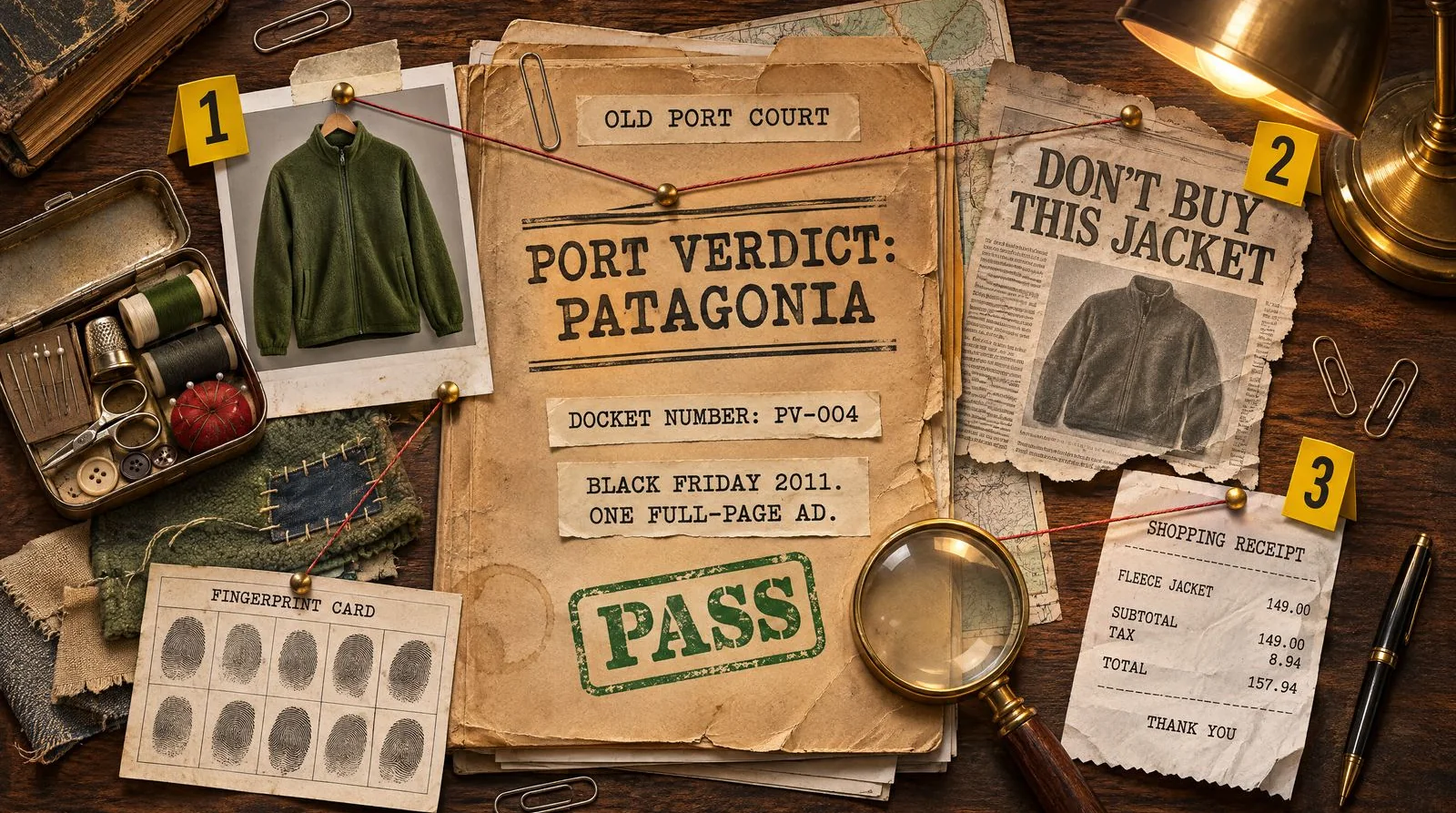
The case in brief
On Black Friday 2011 Patagonia ran a full-page New York Times ad telling readers not to buy its best-selling fleece, backed by a pledge to reduce, repair, reuse and recycle. The ad cost little, drew wide attention and was followed by strong sales growth, which critics see as its central contradiction.
The case in numbers
The case
On Black Friday, 25 November 2011, Patagonia bought a full page in The New York Times and filled it with a photograph of its own R2 fleece under the headline "Don't Buy This Jacket". The copy set out what that one best seller cost the planet: 135 litres of water to make, nearly 20 pounds of carbon dioxide to ship it from its origin to Patagonia's Reno warehouse, and waste equal to about two-thirds of its weight. It then asked readers to buy less and to think before spending money on that jacket or anything else.
The ad was not a stand-alone stunt. It promoted the Common Threads Initiative, which Patagonia had launched on 7 September 2011 with a pledge built on five words: reduce, repair, reuse, recycle and reimagine. According to the launch release, the programme included a Patagonia storefront on eBay for used Patagonia gear, from which the company said it took no profit.
The decision on trial is whether a growing clothing company should spend the biggest retail day of the year telling people not to buy its products, and whether the result, which included higher sales, makes the campaign a success or a contradiction.
The evidence
How the decision was made
The fullest inside account comes from David Gelles's 2025 book on founder Yvon Chouinard, excerpted on his Substack. In his telling, executives Rick Ridgeway and Vincent Stanley were looking for a way to tell the company's story after the 2008 financial crisis. An earlier idea to close stores on Black Friday behind crime scene tape was rejected. Ridgeway then drew on a 1990 Esprit ad, "A Plea for Responsible Consumption", and took a mock-up to the board. Chouinard was open to it. Former chief executive Kris McDivitt Tompkins was sceptical, warning that the message could look hypocritical and cost sales in the most important trading period of the year. The board approved a revised version.
The same account quotes the then chief executive, Casey Sheahan, putting the cost of the ad at USD 57,000 and estimating that it generated USD 40 million to 50 million in free publicity. Those are the company's own estimates, not audited figures, but even with a heavy discount the ratio of cost to attention was unusual.
What happened in the weeks after
Reporting by Outside in December 2011 gives the most concrete early numbers. The ad also ran online through Cyber Monday and was emailed to about 750,000 customers. Around 8,000 people had taken the Common Threads pledge since September; about 13,000 more signed in the week after the ad, against a goal of 50,000 by September 2012. Adweek named it ad of the day.
Criticism arrived just as fast. Gawker called the ad smug. Readers on Patagonia's own blog asked why, if the company was serious about cutting consumption, it did not close its stores. Others pointed out that Patagonia still manufactured overseas and released new technology every season. The company did not claim to have solved the problem. In a blog response quoted by GreenBiz (now Trellis), Patagonia wrote that it was "not yet entirely there" and that not every product met its own criteria.
The sales question
This is the heart of the case against the ad. Patagonia is privately held, so there are no public filings, but press reports point the same way. Bloomberg reported in August 2013, under the headline "Patagonia's 'Buy Less' Plea Spurs More Buying", that sales rose almost a third to USD 543 million in 2012, and that the company opened 14 more stores that year. PBS NewsHour reported growth of 25 to 30 percent a year since the ad, though without citing a source. In the same PBS report, chief operating officer Doug Freeman said the company hoped existing customers would indeed buy less, while it attracted new customers who shared its values.
Two points complicate the simple story that the ad sold more jackets. First, Patagonia was already growing fast: Outside reported that the company expected 2011 sales to rise 15 to 25 percent on 2010, before the ad ran. Second, no one has published a controlled measure of how much of the later growth the ad caused, or whether pledge-takers did in fact buy less. The honest reading is that the campaign coincided with, and probably contributed to, strong growth, but its precise effect is unknown.
Whether the pledge was backed by action
What separates this campaign from a one-day provocation is what followed. On Black Friday 2013 Patagonia released a short film, Worn Wear, about customers who had repaired and kept their clothing, and held parties at 15 stores with free repair guides made with iFixit. In September 2017 it opened a dedicated Worn Wear online store selling used Patagonia gear, with in-store trade-ins earning credit of USD 30 to 100. Repair, resale and take-back became permanent parts of the business rather than lines in an ad.
The verdict
PASS. As a marketing decision, the ad did what its makers intended. It cost little, reached far beyond the readers of one newspaper, and attached Patagonia's name to an idea, buy less and buy better, that the company then backed with years of repair and resale programmes. The ad never asked Patagonia to shrink. It asked customers to change how they bought, and competed for the purchases they still chose to make. On that test, the evidence supports it.
The caveats are serious and should not be waved away. Rising sales almost certainly meant a larger absolute footprint, which sits awkwardly beside a message about consumption. There is no independent evidence that pledge-takers bought less. Most of the commercial figures are press reports about a private company, and the publicity estimate is the chief executive's own. Finally, the approach worked because Patagonia had decades of credibility behind it, including a switch to organic cotton in 1996 and co-founding 1% for the Planet in 2002, as Outside noted. A brand without that record, borrowing the same line, would invite the greenwashing charge and probably deserve it.
What Indian brands can take from it
Sustainability claims are now common on Indian packs and in D2C ads, often with little behind them. Patagonia's case offers a stricter standard:
- Earn the right before you say it. A provocative purpose message lands only when your record already supports it. Start with product and policy, then talk.
- Build the infrastructure behind the slogan. Repair services, resale channels and take-back schemes turned Patagonia's line into something customers could act on.
- Admit the contradiction in public. Patagonia said it was "not yet entirely there". Owning the gap is more credible than pretending it does not exist.
- Measure behaviour, not only buzz. Track pledges, repairs and resale volumes alongside sales, so you can show whether the message changed anything.
If you are shaping a purpose-led position, our brand strategy team can help you test whether you have earned it first. For the wider picture on building trust in a direct-to-consumer brand, read our guide to D2C brand building in India.
Timeline
Patagonia launches the Common Threads Initiative and a used-gear storefront with eBay.
"Don't Buy This Jacket" runs as a full page in The New York Times on Black Friday.
Outside reports about 13,000 new Common Threads pledges in the week after the ad.
Sales rise almost a third to USD 543 million and Patagonia opens 14 more stores.
Patagonia releases the Worn Wear film and hosts repair-themed Black Friday parties.
Patagonia opens a dedicated Worn Wear online store for used gear.
David Gelles's book reports the ad cost USD 57,000, per former CEO Casey Sheahan.
Lessons for Indian brands
- A purpose message that runs against short-term sales can build a brand, provided the company backs it with real programmes.
- Cheap, provocative media can earn far more attention than it costs when the idea is simple and the timing is deliberate.
- Strong sales after an anti-consumption ad expose a contradiction that a brand must acknowledge rather than hide.
- Credibility built over decades is what allows a brand to make a claim that would look like greenwashing from anyone else.
Questions people ask
When did Patagonia run the Don't Buy This Jacket ad?
It ran as a full page in The New York Times on Black Friday, 25 November 2011. Outside reported that it also ran online through Cyber Monday and was emailed to about 750,000 customers.
Did Don't Buy This Jacket increase Patagonia's sales?
Sales grew strongly afterwards: Bloomberg reported they rose almost a third to USD 543 million in 2012. Patagonia had already forecast 15 to 25 percent growth for 2011 before the ad, so not all of that growth can be credited to it.
What was Patagonia's Common Threads Initiative?
Launched in September 2011, it asked customers to reduce, repair, reuse, recycle and reimagine, with Patagonia committing to durable products, repairs and take-back. It included an eBay storefront for used Patagonia gear, from which Patagonia said it took no profit.
How much did the Patagonia New York Times ad cost?
Former chief executive Casey Sheahan put the cost at USD 57,000 and estimated USD 40 million to 50 million in free publicity, according to David Gelles's 2025 book. Both are the company's own estimates.
Evidence
- Patagonia: Don't Buy This Jacket, Black Friday and the New York Times
- PR Newswire: Patagonia launches Common Threads Initiative
- David Gelles: The secret history of "Don't Buy This Jacket"
- Outside: Not buyin' it
- Trellis (GreenBiz): Patagonia's conscientious response to Black Friday consumer madness
- Bloomberg: Patagonia's "Buy Less" plea spurs more buying
- PBS NewsHour: Clothing company's anti-consumerist message boosted business
- TriplePundit: Patagonia Black Friday campaign urges customers to repair worn clothing
- FashionNetwork: Patagonia launches official Worn Wear online store
Port Verdict is independent commentary based on public sources. Brand names are trademarks of their owners; no affiliation is implied.