
Docket PV-002 · Crisis Communications · 2026
KitKat lost 413,793 bars to thieves and turned it into a campaign
On trial: Was KitKat right to turn a real cargo theft into a playful, public brand campaign?
PASS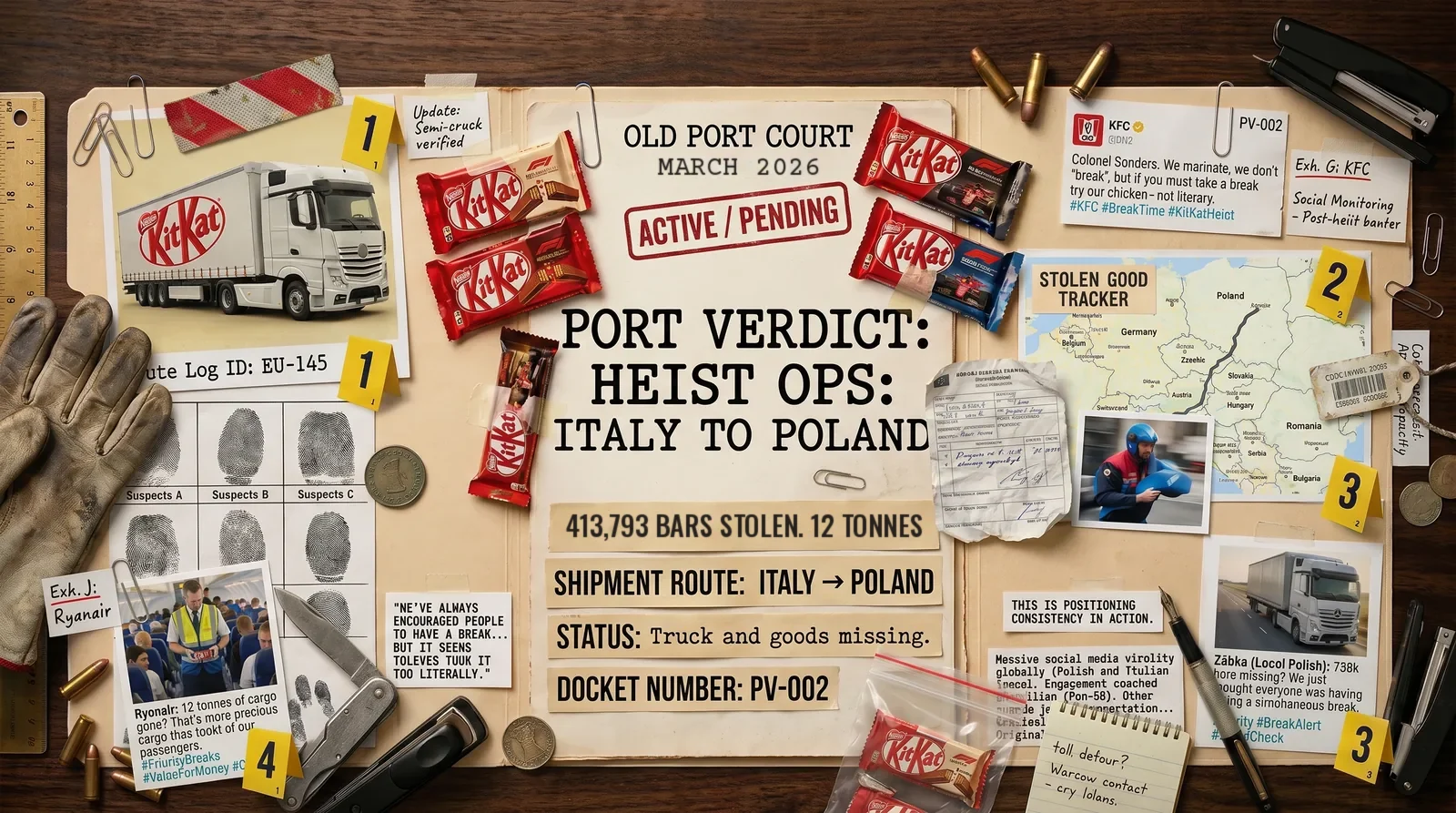
The case in brief
In late March 2026 a lorry carrying 413,793 Formula 1 themed KitKat bars disappeared in transit from Italy to Poland. KitKat answered with slogan-led humour and a public batch-code tracker, and the response won the PR Grand Prix for crisis communications at Cannes Lions.
The case in numbers
The case
A week or so before Easter 2026, a lorry left a Nestle factory in central Italy bound for Poland, where its cargo was to be distributed to markets along the way. It never arrived. KitKat confirmed to AFP on 28 March that the vehicle and its load were still missing. The cargo was 413,793 bars, roughly 12 tonnes, from a new range. Trade and sports outlets, including Confectionery Production, reported that these were mini bars shaped like racing cars, made for KitKat's new partnership with Formula 1.
A theft is not a marketing decision. What is on trial is how the brand chose to respond. KitKat had at least three options: say nothing and let the police work, issue a dry supply-chain statement, or step into the story. It chose the third, and leaned on the very line that has defined it for decades.
The evidence
What is verifiable about the theft
The core facts come from Nestle's own statements, carried by AFP and AP. The bar count, the 12 tonne weight, the Italy to Poland route and the fact that both truck and cargo were unaccounted for are consistent across reports. Nestle did not disclose where exactly the lorry was taken, and the precise date of the theft varies slightly between outlets, so it is safest to say late March 2026. In the coverage we reviewed, no arrests or recovered stock had been reported. Nestle said there were no safety concerns, that wider supply was not affected, and that investigations were continuing with local authorities and supply chain partners. It also warned the bars could surface through unofficial sales channels in Europe.
Act one: the joke that was also a warning
A KitKat spokesperson told AFP the brand had always encouraged people to have a break, and that thieves had apparently taken the message too literally. The tone was light, but the statement carried real information: what was missing, why it mattered before Easter, and that every bar had a batch code that could identify it. According to Cision's analysis, KitKat's follow-up post on X on 29 March, reassuring people about safety and supply, became the most engaged post about the theft.
Act two: the Stolen KitKat Tracker
On 1 April, KitKat launched an online Stolen KitKat Tracker. Anyone could enter the eight-digit batch code from a wrapper and learn whether the bar came from the missing consignment, with instructions to report a match. Launching on April Fools' Day invited disbelief, so the brand stated plainly on social media that this was neither a stunt nor a prank, as reported by Business Insurance. Other brands, including Domino's UK and Ryanair, joined in with their own jokes.
What the results claim
Measured reach comes mostly from interested parties, so treat it accordingly. Cision, a PR software vendor, counted more than 13,000 media mentions over 30 days, up 225 percent on the previous period. WPP, whose agencies Burson and VML worked on the response, claims more than 6,000 articles, over 800 million in earned reach and more than 2.2 million tracker engagements in its case study. It offers no sales figures. The independent signal is the industry's judgement: in June 2026 the work, entered as The KitKat Heist, won the PR Grand Prix in Crisis Communications and Issue Management at Cannes Lions, plus four Gold Lions, according to ESM Magazine.
What happened to the bars, and what was measured
The recovery story briefly went wrong in public. On 31 March several Italian outlets, including La Stampa and Sky TG24, reported that the lorry and its cargo had been found, citing the company. Nestle denied it. Il Post reported on 2 April that it was still unclear where the truck and bars were, that there were no known suspects, and that Nestle was continuing to work with police. A few outlets carried the recovery claim without the correction, which is a reminder to check any update against the company's own statements.
We found no later report of recovered stock or arrests, including in the trade coverage around Cannes in late June. WPP's case study says the tracker produced genuine leads for the police investigation, but it gives no count of batch-code matches. Its other new claims are about attention, not sales: daily views rising from about 1 million to 29 million at the peak, a 44 percent share of views on Meta, nearly three times the closest competitor, and more than 115 brands joining the story. None of these figures has been independently audited, and Nestle has not published any sales effect.
The verdict
PASS. The response did what good crisis communication should: it got ahead of the story, told people the useful facts (no safety risk, supply largely fine, watch for grey-market stock), and gave the public something practical to do. The humour worked because it sat on a slogan everyone already knows, and because nobody was hurt. The tracker turned a loss into a reason to pick up a bar and check it.
The caveats are real. Almost every number comes from Nestle or its partners. The tracker's value to the actual investigation has not been independently shown, and the cargo, as far as published reporting shows, was not recovered. The timing on 1 April also meant some of the public assumed it was fake, which the brand had to deny. And this playbook only works for a victimless loss: had a driver been injured, the same jokes would have been a disaster.
What Indian brands can take from it
Indian FMCG and D2C brands deal with counterfeits, diverted stock and grey-market resale every week, usually in silence. KitKat's response suggests some disciplined ways to speak up:
- Check the human stakes first. Humour is only available when nobody is harmed. Decide that before anyone drafts a post.
- Lead with useful facts, then add wit. Safety, availability and what customers should do came first in every KitKat statement.
- Use the assets you already own. Batch codes and a famous line did the heavy lifting. Brands with QR or serial codes on packs can build verification tools that double as engagement.
- Measure honestly. Separate earned reach from business outcomes, and do not let an agency case study stand in for sales data.
Our social media management and creative direction teams help brands plan these real-time responses before they are needed. More on brand voice lives in The Logbook.
Timeline
A lorry carrying 413,793 F1 themed KitKat bars disappears between Italy and Poland.
KitKat confirms to AFP that the lorry and cargo are missing.
A KitKat post on X about safety and supply becomes the most engaged post on the theft.
Some Italian outlets report the cargo found; Nestle denies it.
KitKat launches the Stolen KitKat Tracker and says it is not an April Fools' prank.
The KitKat Heist wins the PR Grand Prix for Crisis Communications at Cannes Lions.
Lessons for Indian brands
- A real-world setback can become a brand moment when the response is fast, factual and built on a line the public already knows.
- Humour in a crisis is only safe when nobody has been harmed and the practical facts come first.
- Giving people a simple action, such as checking a batch code, keeps a story alive beyond the first news cycle.
- Reach figures from vendors and agencies are claims, not proof of commercial impact.
Questions people ask
How many KitKat bars were stolen?
Nestle said 413,793 bars, roughly 12 tonnes, from KitKat's new Formula 1 range went missing in late March 2026 while being transported from Italy to Poland.
Were the stolen KitKat bars ever found?
Some Italian outlets reported on 31 March 2026 that the cargo had been found, but Nestle denied it, according to Il Post. We found no later report of recovered stock or arrests.
What was the Stolen KitKat Tracker?
An online tool launched on 1 April 2026 where anyone could enter the eight-digit batch code from a wrapper to check whether the bar came from the stolen consignment, with instructions to report a match.
Did the KitKat heist response win at Cannes Lions?
Yes. Entered as The KitKat Heist, it won the PR Grand Prix in Crisis Communications and Issue Management at Cannes Lions 2026, plus four Gold Lions, according to ESM Magazine.
Evidence
- Arab News (AFP): Sweet heist? Nestle says 12 tonnes of KitKat stolen
- ABC11 (AP): Nestle says 413,793 KitKat candy bars stolen en route from Italy to Poland
- Confectionery Production: Nestle launches investigation after theft of 413,000 new KitKat series
- exchange4media: KitKat launches Stolen KitKat Tracker
- Business Insurance: KitKat crowdsources recovery after 12-ton chocolate heist
- Cision: Inside the KitKat chocolate heist response
- WPP: How KitKat turned a 12 tonne disaster into a global brand triumph
- ESM Magazine: KitKat steals the show at Cannes Lions with Grand Prix win
- Il Post: Un'inattesa occasione di marketing per KitKat (2 April 2026)
Port Verdict is independent commentary based on public sources. Brand names are trademarks of their owners; no affiliation is implied.