
Docket PV-011 · Advertising · 2020
Burger King let its Whopper rot on camera to sell the absence of preservatives
On trial: Was Burger King right to show its flagship burger covered in mould to prove it had removed artificial preservatives?
MIXED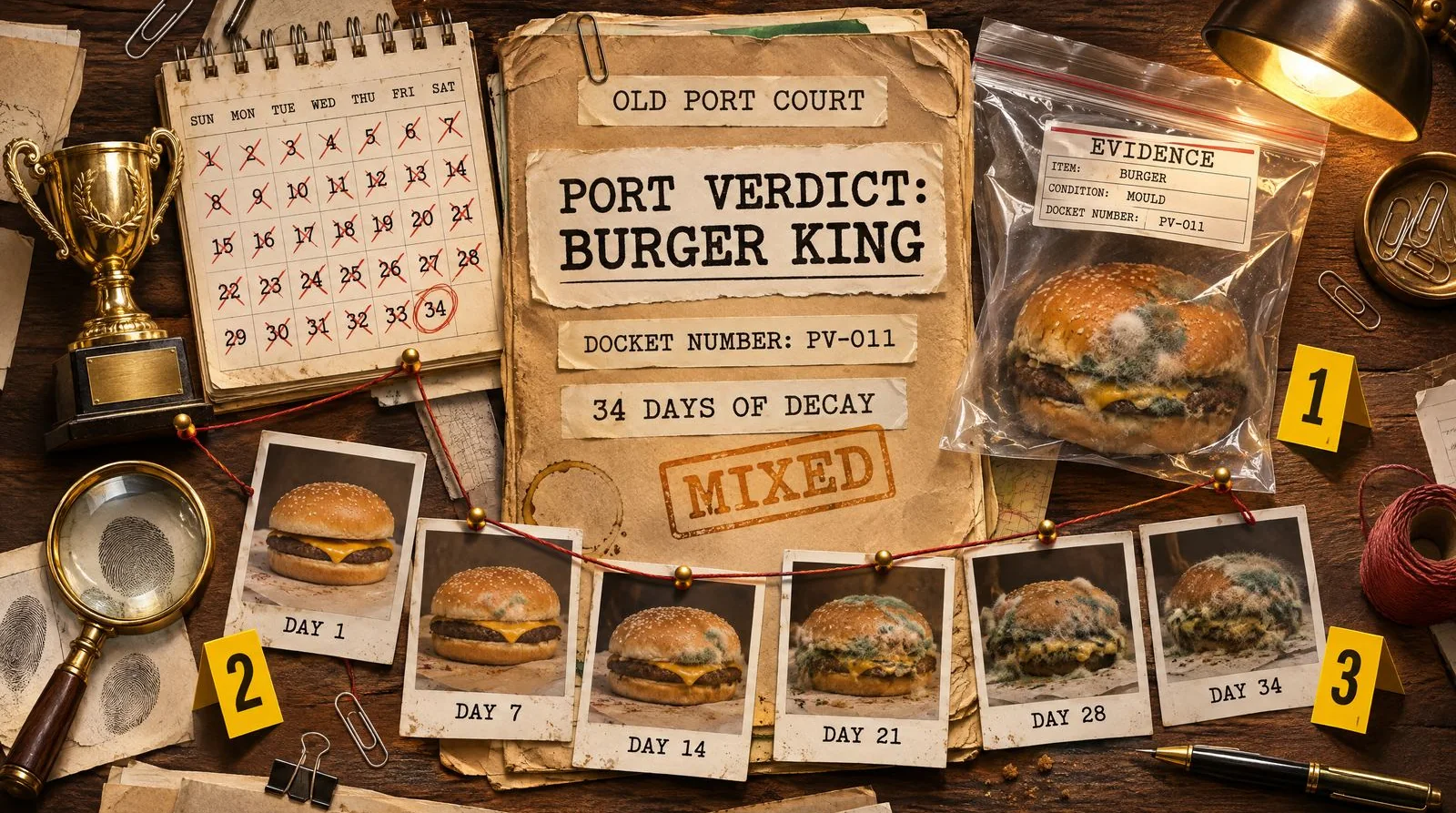
The case in brief
In February 2020 Burger King advertised a Whopper rotting over about five weeks to prove it had dropped artificial preservatives. The work became one of the most awarded campaigns of its era, but independent pre-tests found it put many viewers off, and the only sales uplift on record is an agency claim.
The case in numbers
The case
On 19 February 2020 Burger King released a campaign built around one image: a Whopper left to decay until it was covered in mould, with the line "The beauty of no artificial preservatives". The hero film was a time-lapse of the burger rotting over 34 days, and the print and outdoor executions were labelled by day, up to Day 35. The work came from three agencies, INGO in Stockholm, David in Miami and Publicis, and ran across film, print, outdoor and social.
The news behind it was a product change. Burger King had already removed artificial preservatives from the Whopper in most European markets, and in the United States more than 400 restaurants were selling the new version at launch, with every US restaurant due to follow by the end of 2020, according to Marketing Dive. Global CMO Fernando Machado told Business Insider that the team knew some people would think the approach was too risky or would hurt the brand, and that the company had waited for its supply chain, costs and staff training to change before saying anything.
The decision on trial is not the recipe change, which few would argue with. It is the choice to communicate it by showing the product at its least appetising. Fast food advertising normally spends heavily on making burgers look perfect. Burger King bet that proof would persuade more than polish, and that a moment of disgust would turn into trust.
The evidence
Was the claim real?
This part holds up. Nation's Restaurant News reported that on 17 September 2020 Burger King completed the US rollout of a Whopper free of artificial colours, flavours and preservatives, and said 85 percent of its permanent US menu items were now free of them. The company put the total amount of artificial ingredients removed worldwide at about 8,500 tons, a figure that comes from Burger King itself. The point matters for the verdict: an advertisement that dramatises a product change is only as strong as the change. Here the operations came first and the advertising followed, which is the right order and the reason the idea was defensible at all.
What viewers said before the awards
Independent ad testing within days of launch was unkind. Ace Metrix, an ad-testing company, found the US film scored 36 percent below the quick-service restaurant norm for desire, and 26 percent of viewers said it made them less likely to buy from Burger King. Viewers called it "gross", "inappropriate" and "ridiculous". Yet attention was 10 percent above the norm among those who watched to the end, and viewers rated the message itself, that the Whopper had no artificial preservatives, as the best thing about the ad.
System1, which predicts long-term effects from emotional response, gave the ad one star out of five for brand building but a relatively strong short-term "spike" score of 1.59, and said it produced the most disgust it had measured in an advert since 2012, as reported by LBB. Both tests point the same way: people noticed and understood the ad, and many of them did not want to eat after seeing it.
The creative verdict
Industry juries saw it differently. In June 2020 the campaign was named Best of Show at The One Show, winning 18 Gold Pencils and helping David Miami to Agency of the Year, according to Adweek. At Cannes Lions in June 2021 it took the Outdoor Grand Prix and a Gold Lion in Film. In 2022 it won a Gold Lion in the Creative Effectiveness category, which is meant to reward work with proven results, although the public entry page lists no figures.
The sales question
This is where the record thins out. WPP, whose agency David worked on the campaign, claims a 14 percent sales increase, 8.4 billion impressions, USD 40 million in earned media value and an 88 percent uplift in positive brand sentiment in its case study. It names no market, period or baseline for the sales figure, and we could find no independent study that tests it.
The parent company's own numbers do not settle the matter either. Restaurant Brands International reported that Burger King's US comparable sales fell 5.6 percent in 2020 and 2.9 percent in the fourth quarter, with global comparable sales down 7.9 percent. The pandemic hit restaurant traffic within weeks of the launch, so those figures can neither prove nor disprove the campaign's effect. What can be said is that nothing in the public filings shows a visible Whopper-led lift.
The verdict
MIXED. As a piece of communication, the Moldy Whopper did something difficult: it made an invisible ingredient change visible, memorable and impossible to misread. It was backed by a real operational change, it earned enormous free coverage, and the industry rewarded it more than almost anything else of its era. On creative and strategic clarity, it deserves its reputation.
The case against is about appetite and proof. The only independent measurements we found, from Ace Metrix and System1, show a clear cost in desire and long-term brand feeling, and roughly a quarter of tested viewers said they were less likely to buy. The headline sales uplift comes from the agency network that made the work, without the detail needed to check it, and Burger King's reported US sales fell in 2020 for reasons that swamp any campaign effect. A food brand showing its food rotting won the argument about preservatives. Whether it won more customers than it put off is not something the public evidence can tell us.
What Indian brands can take from it
Indian packaged food, QSR and D2C brands increasingly lead with clean-label claims such as no preservatives, no maida or no added sugar. The Moldy Whopper shows both the power and the price of proving such a claim dramatically:
- Change the product before you advertise it. Burger King waited until its supply chain could deliver the claim. A clean-label campaign that runs ahead of the factory is a regulatory and reputational risk.
- Proof can beat polish, but test the appetite cost. Pre-test food creative for desire, not just recall, and decide in advance how much disgust the brand can afford.
- Think about where the shock lands. Ace Metrix warned against placing the images near restaurants. Keep provocative creative away from the moment of purchase, and give the purchase moment a more appetising version.
- Do not confuse awards with effectiveness. Ask for the market, period and baseline behind any sales uplift before it goes into a board deck.
If you are planning a claim-led campaign and want to pressure-test it first, our creative direction and brand strategy teams can help.
Timeline
The Moldy Whopper launches; over 400 US restaurants already sell the Whopper without artificial preservatives.
Ace Metrix and System1 publish tests showing low desire scores and record disgust.
The campaign is named Best of Show at The One Show with 18 Gold Pencils.
Burger King completes the US rollout of the Whopper free of artificial preservatives.
RBI reports Burger King US comparable sales down 5.6 percent for 2020.
The work wins the Outdoor Grand Prix and a Film Gold Lion at Cannes Lions.
It wins a Gold Lion in the Cannes Creative Effectiveness category.
Lessons for Indian brands
- Proof beats polish for an ingredient claim, but only when the product change is complete before the advertising runs.
- Showing food at its least appetising has a measurable cost in desire, so pre-test it and plan where it appears.
- Awards measure creative distinction and fame, not sales, and should not be read as effectiveness evidence on their own.
- An agency-reported sales uplift needs a market, a period and a baseline before it counts as evidence.
Questions people ask
What was Burger King's Moldy Whopper ad?
A February 2020 campaign by INGO, David Miami and Publicis that showed a Whopper decaying over 34 days to prove Burger King had removed artificial preservatives. It ran as film, print, outdoor and social with the line "The beauty of no artificial preservatives".
Did the Moldy Whopper increase sales?
WPP, whose agency worked on it, claims a 14 percent sales increase but gives no market, period or baseline. Burger King's US comparable sales fell 5.6 percent in 2020, a year dominated by the pandemic, so no public data independently confirms a sales effect.
Did Burger King actually remove preservatives from the Whopper?
Yes. Most European markets had already made the change, and Burger King completed the US rollout of a Whopper free of artificial colours, flavours and preservatives on 17 September 2020.
What awards did the Moldy Whopper win?
It was Best of Show at The One Show 2020 with 18 Gold Pencils, won the Outdoor Grand Prix and a Film Gold at Cannes Lions in 2021, and took a Gold Lion for Creative Effectiveness in 2022.
Evidence
- Marketing Dive: Burger King's Moldy Whopper ad sparks visceral reactions but scores on subversion
- Business Insider: Burger King's marketing boss explains why its Moldy Whopper campaign could pay off
- Nation's Restaurant News: Burger King completes removal of artificial flavors, colors and preservatives from its Whopper nationwide
- LBB: Fresh or funky? System1 crunches the numbers on Burger King's Moldy Whopper
- Adweek: David Miami wins One Show Agency of the Year thanks to Moldy Whopper
- Campaign: Cannes 2021, which Burger King campaign is the best?
- Cannes Lions (Love the Work): Moldy Whopper, Creative Effectiveness 2022
- WPP: David and INGO, Burger King's Moldy Whopper (case study)
- Restaurant Brands International: Q4 and full year 2020 results (Form 8-K, Exhibit 99)
Port Verdict is independent commentary based on public sources. Brand names are trademarks of their owners; no affiliation is implied.